
Cambodia’s brief season of dissent 2013/14
- Ian Miller

- Apr 5
- 2 min read
There are moments in a country’s political life when the air changes—when what once seemed fixed begins, briefly, to loosen. Cambodia experienced such a moment in 2013. It did not last.
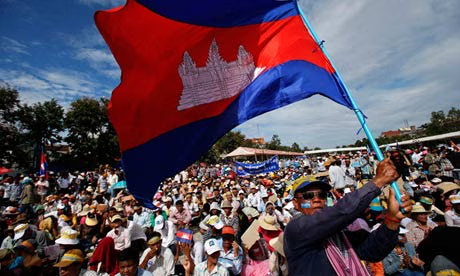
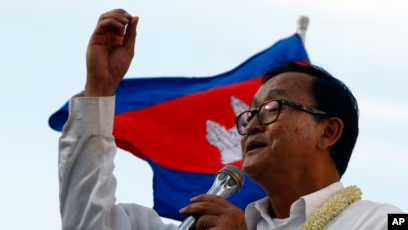
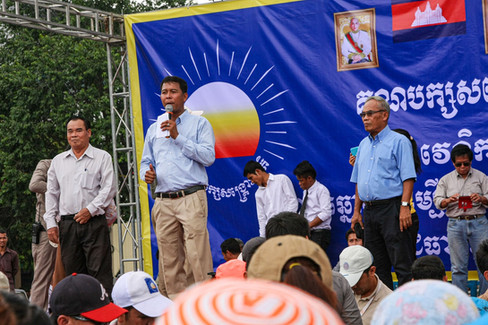
The disputed election of July that year exposed a fault line that had long been present but rarely so visible. The ruling Cambodian People's Party, led by Hun Sen, claimed victory as it had done for decades. But this time the opposition Cambodia National Rescue Party, under Sam Rainsy and Kem Sokha, refused to concede. Allegations of irregularities—familiar, often dismissed—suddenly carried weight because of the numbers willing to stand behind them.
What followed was not merely an opposition campaign. It was, for a few months, a visible expression of a public that had begun to test its own limits.
At Freedom Park in Phnom Penh, crowds gathered in their tens of thousands. Monks, students, garment workers, office staff—the composition mattered. These were not only party loyalists. They were people who had, until then, largely stayed outside overt political confrontation. Their demands were direct: an independent investigation into the vote, accountability, and the possibility—still faint—of political change through pressure rather than patronage.



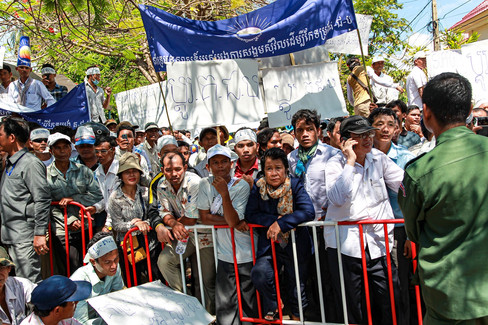


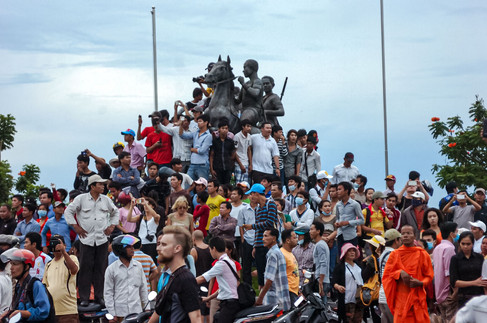



The protests might have remained contained within the language of electoral dispute had they not collided with something more material. Cambodia’s garment workers, the backbone of its export economy, were already mobilising over wages that lagged far behind the cost of living. When they joined the demonstrations, the tone shifted. This was no longer only about ballots; it was about survival.
The convergence unsettled the government. Political protest can be managed. Labour unrest can be negotiated. Together, they present something less predictable.
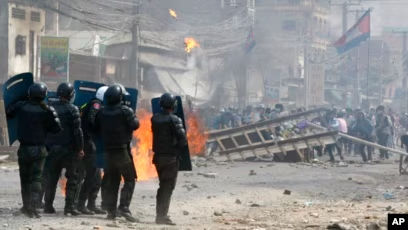
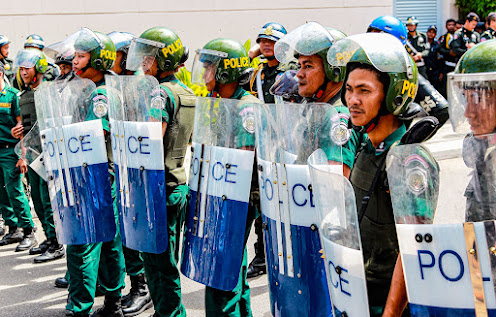
By January 2014, the state’s response had hardened. On Veng Sreng Boulevard, security forces opened fire on striking workers and demonstrators. At least five people were killed. The message was unambiguous. Within days, Freedom Park was cleared, protest leaders were detained or silenced, and public assembly was effectively shut down.
The speed of the crackdown was instructive. It suggested not only a willingness to use force, but a determination to ensure that the brief opening did not become a precedent.
In the months that followed, a political compromise allowed the opposition to take its seats in parliament. For a moment, it appeared that confrontation might give way to negotiation. Yet the deeper trajectory was already set. By 2017, the Cambodia National Rescue Party had been dissolved, its leadership dispersed or detained, and Cambodia’s political landscape returned to a familiar shape—plural in appearance, singular in control.
It is tempting to view the protests of 2013–14 as a failed uprising. They did not produce new elections. They did not dislodge entrenched power. But failure, in this sense, is too narrow a measure.
What those months revealed was a society more politically aware, more willing to assemble, and more conscious of its own grievances than official narratives allowed. They also revealed the boundaries of that awareness—how far it could go, and how quickly it could be contained.
Cambodia’s brief season of dissent did not remake the system. It did, however, expose it. And once seen clearly, even for a moment, such things are not easily forgotten.


Comments