
Fascism is a political ideology and system of Government : Historical Perspectives & Current Issues.
- Ian Miller

- Mar 5
- 5 min read
The word fascism carries a heavy historical weight. It evokes images of marching uniforms, towering banners, and governments that demanded loyalty above freedom. Yet the concept itself is often misunderstood, thrown into political arguments without much explanation of what it actually means. To understand why the term still appears so frequently in discussions about modern politics—especially in the United States—it helps to look at what fascism really is, how it emerged, and why historians remain alert to its warning signs.

The ideology first took recognizable shape in the early twentieth century under Benito Mussolini, who ruled Italy beginning in 1922. Mussolini described fascism as a system where the state stood above all else—individual rights, political pluralism, and democratic compromise were considered weaknesses that diluted national strength. The nation was to be unified under a single vision, led by a powerful authority capable of mobilizing society like an army.
In Germany, Adolf Hitler adapted and radicalized these ideas. Under his rule, the Nazi regime fused authoritarian control with racial ideology and relentless propaganda. Political opposition disappeared, dissent was punished, and the state dictated nearly every aspect of public life.
The resulting system did not just reshape Germany; it plunged the world into the devastation of World War II.

Although fascism is often associated with the imagery of that era—black shirts, swastikas, mass rallies—the deeper structure of the ideology lies in how power operates. Fascism elevates the state and its leader as embodiments of national destiny. Democracy is viewed not as a virtue but as a chaotic system that weakens unity. Instead of debate and compromise, fascist movements promote discipline, obedience, and loyalty.
Yet fascism rarely begins with open dictatorship. Historically, it emerges during periods of instability—economic crises, cultural anxiety, or political paralysis. In such environments, charismatic leaders promise to restore national pride and stability. They frame themselves as protectors of the nation against enemies both internal and external.

Because of this gradual path to power, scholars often examine recurring patterns that appeared in fascist governments. One of the most frequently cited frameworks was compiled by political scientist
Lawrence W. Britt, who studied common traits shared by regimes such as those of Mussolini and Hitler. These traits do not form a strict checklist for identifying fascism, but they offer a lens through which historians analyze political systems.

One recurring sign is the relentless promotion of nationalism. Fascist regimes rely heavily on patriotic symbolism and narratives about national greatness. Citizens are encouraged to believe that their country is exceptional but under threat, and that unity behind a strong leader is necessary to restore its rightful status.
Another pattern is the erosion of civil liberties. Governments may justify restrictions on rights by claiming they are necessary for security or national survival. In such environments, dissent becomes suspect, and critics can be labeled as traitors or enemies of the nation.
The identification of enemies is itself a powerful tool. Fascist movements frequently unite supporters by focusing anger toward particular groups—political opponents, ethnic minorities, immigrants, or ideological adversaries. By framing these groups as dangers to the nation,
leaders create a climate in which repression appears justified.
Military power often takes on a symbolic role as well. Armed forces and security services are elevated as guardians of national strength. Large military budgets, public celebrations of soldiers, and the normalization of force in politics become common features.
Another recurring characteristic is the tightening control over media and information. This control does not always begin with direct censorship. Sometimes it appears first through intimidation, political pressure, or the gradual consolidation of media ownership by allies of the government. Over time, the range of acceptable public debate narrows.
Fascist systems also tend to cultivate an atmosphere of permanent threat. National security becomes a constant justification for expanded authority. Governments argue that extraordinary powers are necessary because danger is always just beyond the horizon.

Religion can also become intertwined with political authority. Leaders may invoke religious identity as a defining element of the nation, presenting themselves as defenders of faith as well as the state.
At the same time, corporate power often finds protection within these systems. Fascist governments historically forged alliances with large business interests, trading political stability and labor suppression for economic cooperation.
Labor unions, on the other hand,
frequently lose independence. Workers’ movements that challenge state authority are restricted, absorbed into government structures, or dismantled entirely.
Intellectuals and artists often become targets as well. Universities, journalists, and cultural figures can be portrayed as elitist or unpatriotic. In such climates, expertise itself may be dismissed as propaganda from hostile institutions.
Law-and-order rhetoric also plays a prominent role. Fascist movements place strong emphasis on crime, punishment, and expanding police powers. The promise of security becomes a central political message.
Within the ruling circles, loyalty frequently outweighs competence. Cronyism and corruption become common as leaders reward allies with positions of influence, regardless of qualifications.
Finally, elections may continue to exist but gradually lose their integrity. Manipulation, voter suppression, or propaganda campaigns can tilt the playing field until democratic competition becomes largely symbolic.
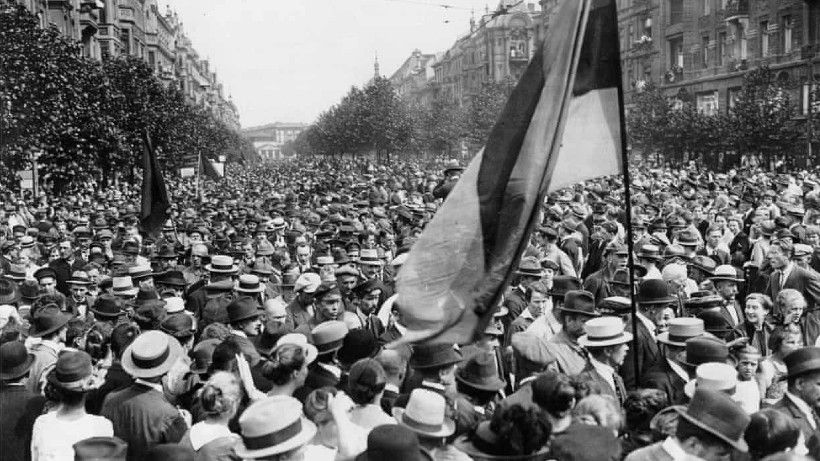
These patterns are studied not because they prove fascism is present in any particular country, but because history shows how fragile democratic systems can be. The collapse of the Weimar Republic in Germany during the early 1930s remains one of the most sobering examples. What began as a constitutional democracy slowly unraveled under political polarization, economic crisis, and the growing influence of authoritarian movements.

In the United States today, the word fascism has become part of an intense political argument. Critics of Donald Trump and the populist movement surrounding him argue that certain political behaviors—attacks on election legitimacy, hostility toward independent institutions, and strong nationalist rhetoric—resemble historical warning signs.
Supporters reject that comparison, pointing out that the United States still maintains competitive elections, independent courts, and a diverse media landscape. From their perspective, calling modern American politics fascist is an exaggeration driven by partisan conflict.
Most political scientists fall somewhere between these two extremes. Rather than declaring the United States fascist, they often discuss the concept of democratic backsliding—the gradual weakening of democratic norms and institutions without the immediate collapse of the system.
That distinction matters. Fascism, in its historical form, represents a fully authoritarian state. Democratic backsliding refers to earlier stages where institutions still function but are under increasing strain.
The debate itself reflects a deeper concern: the resilience of democracy. History shows that the greatest threats to democratic systems do not always come from sudden coups. More often, they appear gradually, through erosion of norms, concentration of power, and growing distrust in elections or institutions.
For that reason, the lessons of the twentieth century remain relevant. The catastrophes that culminated in World War II did not emerge overnight. They developed through a series of political shifts that many people initially dismissed as temporary or unlikely to go too far.
Understanding fascism, therefore, is not only about studying the past. It is also about recognizing how political systems evolve—and how fragile the balance between freedom and authority can become when societies face uncertainty and fear.


Comments