
Pauline Hanson - Australia's tRump

For nearly three decades, Pauline Hanson has occupied a unique place in Australian politics: part insurgent, part populist, part cultural lightning rod. Few politicians have divided opinion as sharply, or endured as stubbornly.

Born in Brisbane in 1954 and raised in working-class Queensland, Hanson did not emerge from the traditional political establishment. She was not a lawyer, academic or party operative. She ran a fish-and-chip shop, worked in small business and lived the kinds of economic uncertainties familiar to many Australians outside the nation's wealthier suburbs. When she entered politics in the 1990s, she carried with her a bluntness that supporters viewed as honesty and critics regarded as recklessness.
Her rise was sudden and explosive.
In 1996, Hanson won the federal seat of Oxley after being disendorsed by the Liberal Party over controversial comments about Indigenous welfare and multiculturalism. Her maiden speech to Parliament would become one of the most discussed political addresses in modern Australian history. Hanson argued that ordinary Australians were being ignored by political elites and warned that the nation was being transformed by policies that many voters had never been asked to endorse.
The reaction was immediate.
To supporters, she articulated concerns about immigration, national identity and social cohesion that had been dismissed or ignored by mainstream politicians. To opponents, she gave legitimacy to prejudice and racial division at a time when Australia was attempting to define itself as an increasingly multicultural society.
Either way, the political landscape shifted.
The following year Hanson founded One Nation, a party that tapped into a growing sense of alienation among sections of regional and rural Australia. Long before Brexit, Donald Trump or the rise of European populist movements, Hanson was building a constituency around distrust of political institutions, concerns about globalisation and resentment towards what supporters called the "political class."
Her success alarmed both major parties.
Throughout the late 1990s and early 2000s, One Nation disrupted Australian politics, forcing Labor and the Coalition to confront issues they would often have preferred to avoid. Immigration levels, Indigenous policy, foreign ownership, trade agreements and national sovereignty all became subjects of fierce public debate.
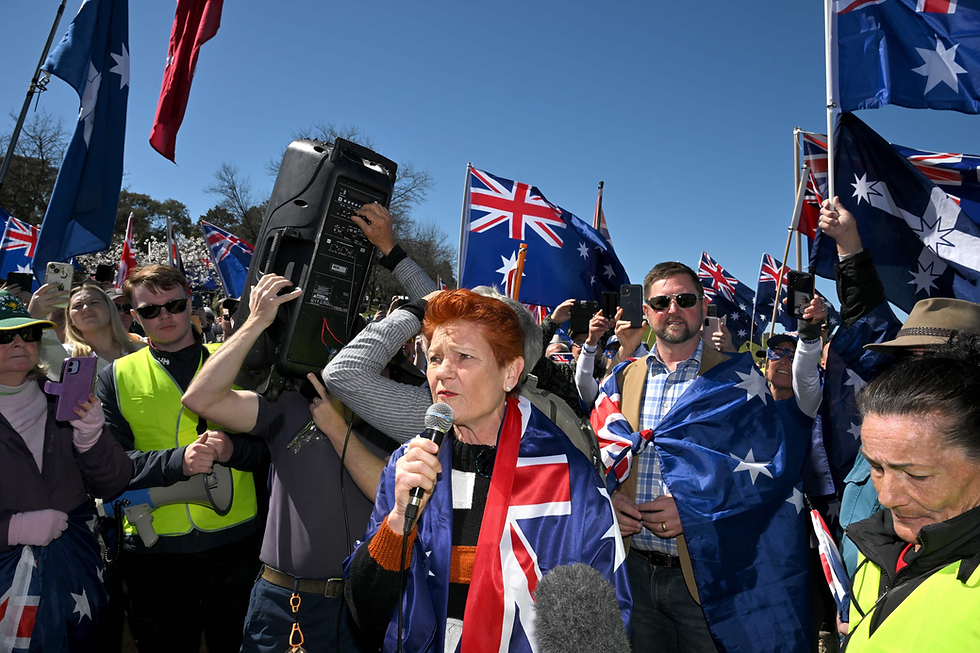
Yet Hanson herself frequently seemed caught between political effectiveness and political controversy.
She attracted headlines with provocative statements about Asian immigration, Islam, Indigenous Australians and multiculturalism. Critics accused her of fostering division and legitimising xenophobia. Supporters argued she was being demonised for expressing concerns shared by millions of Australians.
The pattern would repeat throughout her career.
In 2003 Hanson was imprisoned after being convicted on electoral fraud-related charges. The conviction was later overturned on appeal, but the episode appeared, at least temporarily, to mark the end of her political life. Many observers assumed she would fade into political history.
Instead, she returned.
Repeatedly.
Failed campaigns were followed by new campaigns. Political defeats were followed by comebacks. By 2016 Hanson had returned to federal politics as a senator for Queensland, proving once again that reports of her political demise had been premature.
By then, Australia had changed.
The concerns Hanson had raised decades earlier were no longer confined to the political fringe. Debates about immigration, border security, national identity and the economic impact of globalisation had become central issues across the Western world. While many Australians continued to reject her rhetoric, it became harder to argue that the issues themselves lacked political resonance.
That does not mean Hanson became less controversial.
Her critics continue to argue that she has contributed to social division and that her political success rests upon exploiting fear and grievance. Human rights groups, multicultural organisations and many Indigenous leaders have frequently challenged both her language and policy proposals.
Yet her supporters remain fiercely loyal.
They see a politician who speaks plainly, distrusts bureaucracy and refuses to conform to the conventions of Canberra politics. They admire her willingness to confront institutions and media organisations that they believe have become disconnected from everyday Australians.
What is undeniable is her endurance.
Australian politics is littered with movements that burned brightly before disappearing. Hanson has survived leadership challenges, legal battles, electoral defeats, media ridicule and repeated predictions of irrelevance. Through it all she has remained a fixture in the national conversation.
For her admirers, Pauline Hanson is a voice for Australians who feel unheard.
For her detractors, she represents some of the country's most troubling political instincts.
For historians, she may ultimately be remembered as something else entirely: a politician who identified powerful currents within Australian society long before much of the political establishment recognised they existed.
Whether viewed as a truth-teller, a populist, a divisive figure or a political survivor, Pauline Hanson has left an imprint on Australian politics that few contemporaries can match. Love her or loathe her, she changed the conversation — and Australia is still arguing about it.


Comments