
Pseudo King Donnie.

There’s a familiar rhythm to statements like this from Donald Trump—part political messaging, part personal mythology, and very much designed to dominate the news cycle.
In claiming that America “wouldn’t be a country” without his election, Trump is doing a few things at once. First, he’s centring his presidency as not just consequential, but existential. That’s a step beyond the usual political boast (“we saved the economy”, “we restored order”) into something closer to a narrative of singular rescue—where the nation itself is framed as having stood on the brink of collapse.
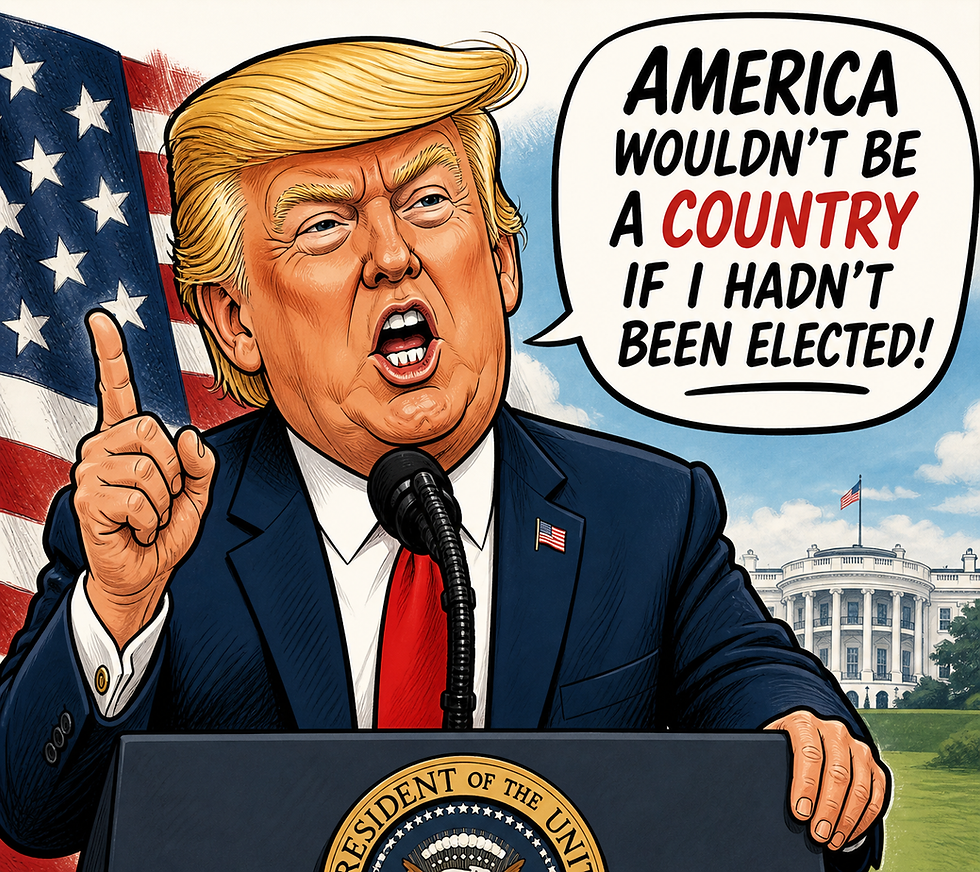
Second, it fits neatly into a long-running rhetorical style: casting the pre-Trump United States as weakened, endangered, or mismanaged, and his own leadership as a corrective force that pulled it back from decline. This kind of framing isn’t unique to him—leaders across the political spectrum have, at times, exaggerated their importance—but Trump’s version tends to be more absolute, more all-or-nothing.
From a factual standpoint, the claim doesn’t hold up in any literal sense. The United States has a deeply entrenched system of institutions—constitutional checks and balances, federal and state governments, courts, and a long continuity of governance—that doesn’t hinge on any single individual. Presidents can shape policy direction, influence global standing, and leave lasting marks, but the idea that the country’s existence depends on one election outcome is more rhetorical than real.
What it does reveal, though, is something about the current political climate. Statements like this resonate with supporters who already see politics in high-stakes, almost apocalyptic terms—where each election feels like a final turning point rather than one chapter in a long, messy democratic process.
There’s also a strategic edge. By framing his past leadership as indispensable, Trump reinforces a broader argument about his future role: that he’s not just a candidate among many, but a necessary figure in moments of national uncertainty.
So while the line grabs attention—and it’s meant to—it’s less a statement of fact than a window into how modern political narratives are built: bold, personal, and often deliberately larger than life.


Comments