
Karen Mulder and the Architecture of Disbelief

Karen Mulder was not the first woman the fashion industry elevated and then abandoned. She was simply one of the most instructive.
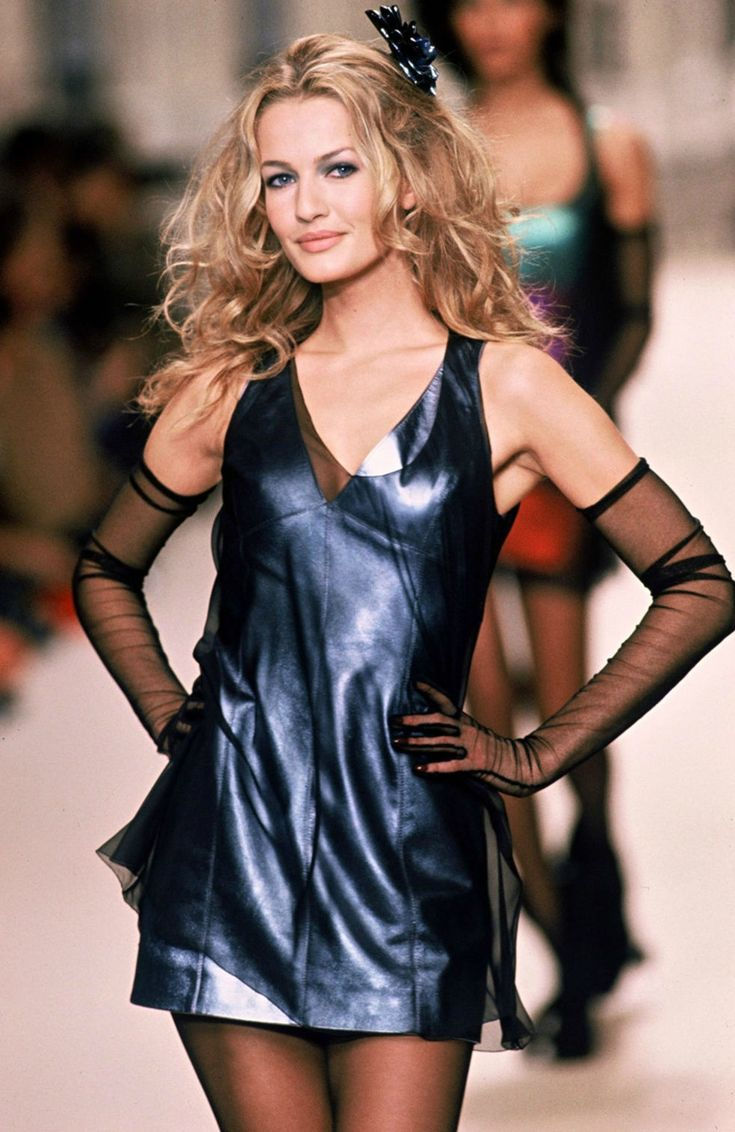
In the early 1990s, Mulder embodied the supermodel ideal at its commercial peak: tall, blonde, icy, flawless. She walked for Versace, Chanel, Yves Saint Laurent. She appeared on Vogue covers and became a Victoria’s Secret Angel. She was not marginal. She was central—profitable, visible, and carefully styled as invulnerable.
What the industry sold was perfection. What it required in return was silence.
By the late 1990s, Mulder had begun to disappear from public life. When she re-emerged in the early 2000s, it was not as a triumphant survivor or a reflective veteran of the runway, but as a woman in visible psychological distress making allegations of sexual abuse—allegations involving powerful men and formative trauma. The response was swift, unified, and devastatingly effective: she was labeled unstable, her claims were treated as incoherent, and her credibility collapsed under the weight of her own suffering.
That collapse became the story.

It is tempting, even now, to frame Karen Mulder as a tragedy of individual fragility—a woman who “couldn’t handle fame,” who “lost her grip,” who “spiralled.” This framing is comfortable because it isolates responsibility. It keeps institutions clean and turns damage into pathology.
But this is not a story about fragility. It is a story about how systems disqualify testimony by weaponising mental health.
The Pre-#MeToo Playbook
When Mulder spoke publicly about abuse, the cultural context was hostile by design. This was a pre-#MeToo world in which credibility was not evaluated by evidence or pattern, but by presentation. Survivors were expected to be calm, linear, restrained—ideally unshaken by the events they described.
Mulder was none of those things.
Her distress became proof of unreliability. Her erratic delivery eclipsed the content of her claims. Media coverage focused not on what she alleged but on how she said it: her demeanour, her coherence, her perceived instability. The implication was clear and rarely challenged—if a woman is psychologically unwell, her account is suspect.
This logic is not only flawed; it is inverted. Trauma frequently manifests as anxiety, dissociation, paranoia, and fragmented memory. Psychological deterioration is not evidence against abuse; it is often one of its most predictable consequences.
Yet the fashion industry had no incentive to make that distinction. Nor did the media, which preferred spectacle to scrutiny. No meaningful investigations followed. No institutions conducted internal reviews. No brands expressed concern or responsibility. Instead, Mulder was hospitalised, then quietly erased.
The system did not rebut her. It outlasted her.
Disappearance as Strategy
What happened next is as revealing as what came before. Karen Mulder did not become a cause célèbre, nor a cautionary tale publicly debated and resolved. She simply vanished from relevance. Her name lingered only as shorthand for collapse—a “sad story,” vaguely remembered, safely unresolved.
This is a familiar manoeuvre. Institutions rarely need to disprove inconvenient women. They only need to wait.
Time does the rest. Memory fades. The absence of prosecution is mistaken for exoneration. The lack of resolution is reframed as insignificance. Silence is mistaken for closure.
Mulder was not vindicated, but neither was she challenged in court. The ambiguity remains—and that ambiguity is precisely the point. Unresolved allegations create no liability. They demand no reform.
A Pattern, Not an Exception
Mulder’s trajectory mirrors that of countless women across industries: elevated while compliant, discarded when disruptive. Models like Gia Carangi were framed as addicts rather than casualties of exploitation. Artists like Britney Spears were deemed unfit rather than overcontrolled. Early accusers like Rose McGowan were dismissed as unstable long before their claims were corroborated.
The pattern is consistent across sectors and decades:
Profit from the woman’s labour or image
Ignore or normalise harm
Discredit her when she speaks
Medicalise her distress
Withdraw support
Let time erase the rest
This is not a conspiracy. It is infrastructure.
What Would Change Today—and What Wouldn’t
In a post-#MeToo environment, Mulder’s allegations would likely be handled differently. Trauma-informed journalism might contextualise her behaviour rather than pathologise it. Brands might initiate internal reviews to mitigate risk. Public discourse would at least ask the correct questions.
But it would be naïve to assume justice would follow.
The core tension remains: powerful systems still benefit from ambiguity. Mental illness is still routinely used to undermine credibility. Women who speak without polish are still penalised. The difference today is not moral clarity, but optics.
What has changed is not the instinct to disbelieve—but the cost of appearing to do so.
Why Karen Mulder Still Matters
Karen Mulder’s story persists because it occupies an unresolved space the culture has not learned how to close. She is neither a proven liar nor a validated whistleblower. She exists in the limbo reserved for women who disrupt power without the institutional stability to survive the backlash.
Her case forces an uncomfortable recognition: truth is not adjudicated solely by facts, but by who is allowed to remain intact long enough to be believed.
Mulder did not fail because she spoke. She failed because speaking cost her the very coherence required to be heard.
The tragedy is not that we do not know exactly what happened to Karen Mulder. The tragedy is that we know exactly what happens to women like her—and continue to call it unfortunate rather than structural.
She was not an anomaly. She was a warning.
And the industry understood it perfectly.
Ian Kydd Miller


Comments