
The old king and the reluctant heir : Nikon 800 to D810

At the top of the used market, the comparison between the Nikon D800 and the Nikon D810 isn’t really about specs. It’s about philosophy — what Nikon thought a “serious” camera should be in 2012, and how quietly, deliberately, they corrected themselves two years later.
PRODUCT COMPARISON TABLE
Attribute | Nikon D800 £288.00•Wex Photo Video + others | Nikon D810 £177.81•eBay - hongyu88 + others |
Release year | 2012 | 2014 |
Sensor | 36.3MP full-frame CMOS | 36.3MP redesigned full-frame CMOS |
Base ISO | 100 | 64 (lower noise floor) |
Image quality | Excellent, class-leading at launch | Refined, cleaner shadows, better tonality |
Processor | EXPEED 3 | EXPEED 4 |
Continuous shooting | 4 fps (FX) | 5 fps (FX) |
Autofocus | 51-point (solid but older tuning) | Improved AF, closer to pro bodies |
Shutter / vibration | Noticeable vibration at high res | Quieter, reduced vibration, electronic front curtain |
Video | 1080p (basic implementation) | 1080p 60fps, cleaner output |
Buffer | Limited | Roughly doubled |
Build | Pro DSLR, weather sealed | Same, slightly refined ergonomics |
Used price (2026) | Lower | Slightly higher |
The D800: ambition, slightly out of control
When the D800 arrived, it felt like Nikon had done something almost irresponsible — a 36MP sensor in a DSLR body at a time when most people didn’t yet know how to handle that level of detail.

It was, for a moment, the sharpest mainstream camera on earth. It topped sensor rankings, delivered staggering dynamic range, and exposed every weakness in your technique.
But it came with a catch.
The D800 demanded discipline it didn’t quite support. The shutter had a bite to it. Mirror slap mattered. Tiny movements showed up as softness. It wasn’t forgiving — and crucially, it wasn’t always consistent. You could do everything right and still feel like the camera was fighting you.
In hindsight, it wasn’t flawed. It was just ahead of its ergonomics.
The D810: same idea, finally under control
The D810 is what happens when a manufacturer listens — not loudly, not publicly, but carefully.
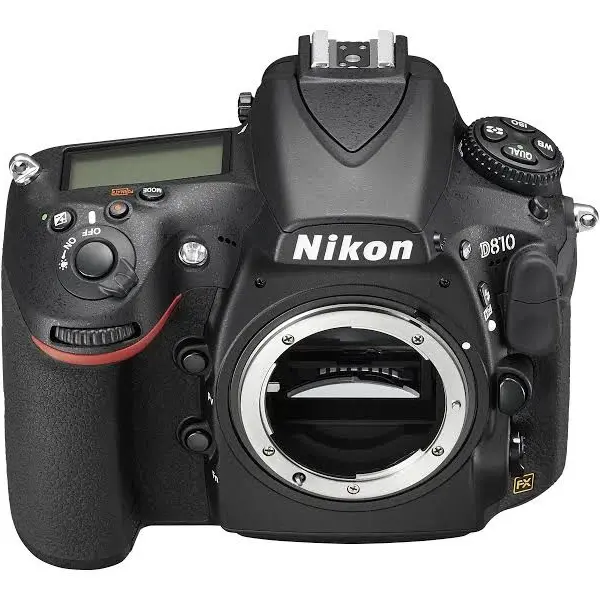
On paper, it looks like a mild update. Same resolution. Same body line. Same intent.
In practice, it’s a different machine.
The shift to a base ISO of 64 lowers the noise floor and gives files a smoother, more elastic feel in the shadows. The shutter is quieter, more damped, less violent.The addition of electronic front curtain shutter reduces micro-vibrations that plagued the D800 at high resolution.
And suddenly, that 36MP sensor becomes usable in the real world, not just on a tripod in perfect conditions.
One reviewer put it bluntly: the D810 is simply a more “well-rounded” camera than the D800 ever was.
Autofocus, speed, and the myth of action
Neither of these cameras is built for modern action work — let’s get that out of the way.
But the D810 edges forward. The autofocus system is still the familiar 51-point module, yet it’s tuned better, feels more decisive, and borrows behaviour from Nikon’s higher-end bodies.
The bump from 4 fps to 5 fps sounds trivial. It isn’t. It shifts the camera from “deliberate only” into something that can at least keep up with real-world movement.
Still, this isn’t a sports camera. It’s a camera for people who anticipate, not chase.
Video: neither here nor there
If the D800 treated video like an afterthought, the D810 treats it like a polite obligation.
Yes, you get 1080p at 60fps, cleaner output, and more control. No, it doesn’t change the fact that both cameras belong to a stills-first era.
In 2026, this is legacy functionality. Useful, but not a reason to buy.
Handling: the invisible difference
This is where the real divide lives — not in specs, but in feel.
The D800 feels like a prototype of the high-resolution DSLR era. The D810 feels like the finished version.
The grip is subtly improved. The shutter is less intrusive. Live View is more usable. The camera stops getting in your way.
It’s the difference between thinking about the camera… and forgetting it.
Nikon D800
Image quality: the same, but not the same
Both cameras produce files that still embarrass much newer gear.
But the D810’s files are calmer. Less brittle. More forgiving when pushed.
At low ISO, the D810’s sensor performance has been described as “class leading” even years later.
This isn’t a leap forward — it’s a refinement. But it’s a refinement you feel every time you open a RAW file.
Nikon D810
The real question: which one should you buy?
The D800 is cheaper. It still delivers astonishing image quality. In controlled conditions, it can match the D810 frame for frame.
But the D810 is the one you trust.
It fixes the friction. It removes the doubt. It lets you concentrate on the photograph rather than the mechanics of making one.
And that, quietly, is everything.
Verdict
The D800 was a revolution. The D810 was the correction.
If the D800 proved what was possible, the D810 proved what was usable.
In 2026, both remain absurdly good for the money. But only one feels like it belongs in your hands rather than on a spec sheet.


Comments