
Why make photos?

Because the world is in constant retreat. Every second collapses into the next. Light shifts, expressions dissolve, buildings rise and fall, power changes hands, children grow older, wars begin and end, and the evidence of it all slips quietly into memory — unreliable, selective, sentimental. A photograph is a counterforce to that erosion. It is a fragment of time held still, a thin slice of existence preserved against the current.
From the beginning, photography carried this strange promise. When Louis Daguerre unveiled the daguerreotype in the 19th century, the shock was not merely technical. It was existential. For the first time, the physical world could imprint itself with mechanical precision. The sun itself became the artist. A face could survive its own aging. A street could outlive its demolition. Death, which had always erased presence, could now be challenged with a small, silvered plate.
But photography did not become powerful because it was precise. It became powerful because it was selective.
The camera is an instrument of exclusion. Every frame is a narrowing. The world is infinite; the rectangle is not. When you raise a camera to your eye, you make a declaration: this, not that. You choose what remains visible and what vanishes. The act seems simple, but it is charged with meaning. The edges of a photograph are moral boundaries. What lies outside them may never be seen.

That is why the photograph has always been political, even when it pretends not to be.
Consider the portrait known as Afghan Girl by Steve McCurry. A young refugee’s eyes confront the viewer — defiant, luminous, haunted. The image circulated across continents, embedding itself into the visual memory of a generation. It did not explain geopolitics. It did not offer statistics. It offered a face. And in that face, abstraction collapsed. Conflict became human. Distance shrank.
The photograph did what paragraphs of analysis often cannot: it compelled attention.
Photography bypasses the rational sequence of argument. Words unfold in time; images strike all at once. Before the intellect organizes a response, the body reacts. Pupils dilate. The chest tightens. The stomach turns. A photograph enters through the senses, not through debate. That immediacy is its seduction — and its danger.
War photographers have long understood this paradox.
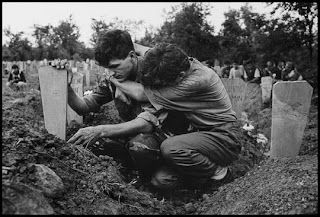
When James Nachtwey documents famine or conflict, he is not simply recording events. He is positioning the viewer in proximity to suffering. He decides where we stand. He decides what we confront. His camera becomes a conduit between distant catastrophe and comfortable living rooms. It carries weight, because it translates violence into visibility.

And yet, visibility is not neutral. A photograph can humanize, but it can also desensitize. Repetition dulls shock. Spectacle competes with spectacle. The flood of images in the digital age has created a strange condition: we see more and feel less. The extraordinary becomes ordinary through sheer exposure. The very power that once startled now risks
becoming background noise.
So why make photos now, in a world already saturated with them?
Because the act of making is different from the act of scrolling.
To make a photograph is to pause. It requires attention. It requires stillness in a culture addicted to speed. The photographer must observe light, anticipate gesture, sense tension in space. You wait. You adjust. You decide. The camera trains the mind to recognize fleeting alignments — the precise instant when form and meaning intersect.
This discipline alters perception. Once you begin to photograph seriously, the world reorganizes itself. You notice the angle of shadows against a wall at late afternoon. You see reflections in windows that others walk past. You observe the choreography of strangers crossing a street. Ordinary scenes reveal geometry and drama. Photography teaches you to inhabit time differently — to inhabit it more consciously.
In this sense, the photograph is not merely an object. It is evidence of attention.
To photograph is to declare that something is worthy of being seen carefully. A cracked sidewalk illuminated by dawn. A worker’s tired posture at the end of a shift. The quiet expression of a mother waiting outside a hospital. These moments might otherwise dissolve into anonymity. The camera resists that erasure.
Photography also serves as witness.
In political crises, images often precede official acknowledgment. A protest suppressed. A building bombed. A line of detainees waiting under floodlights. The camera becomes an instrument of accountability. It can contradict statements, expose contradictions, complicate narratives. In such contexts, photography is not merely art; it is evidence.
And yet, evidence is not immune to distortion. Cropping alters meaning. Context disappears. Digital manipulation blurs boundaries between record and fabrication. The photograph’s authority — once assumed — is now interrogated. We question what we see. We demand verification. The medium that once symbolized truth must now defend itself.
Still, the hunger for images persists. We continue to look for photographs in moments of crisis. We wait for visual confirmation. We search for the frame that will crystallize the event.
Why? Because images shape collective memory.

Consider how history is often recalled not through text, but through singular frames. A soldier raising a flag. A protester facing tanks. A leader addressing a crowd beneath banners. These images become shorthand for complex eras. They compress narratives into symbols. They endure long after the context has faded.
The photograph is therefore both fragment and monument.
But not all photographs aspire to public significance. Many are intensely private. A birthday. A family gathering. A child asleep in a car. These images are less about politics and more about continuity. They are insurance against forgetting. They protect personal histories from the erosion of time.
Memory is malleable. It edits itself. It smooths edges, intensifies emotion, deletes inconvenience. Photographs interrupt that revision. They remind us how we looked, how we dressed, who stood beside us. They return us to places we thought we remembered accurately — only to reveal our distortions.
There is comfort in this. There is also discomfort.
Sometimes photographs expose what we would prefer to ignore: aging, loss, absence. The empty chair at the table. The house that no longer stands. The friend who is no longer alive. In these cases, the photograph becomes a relic — a bridge between presence and absence. It allows grief to anchor itself in something tangible.
Photography is thus entangled with mortality. It exists because we do not.
The 19th century saw the rise of post-mortem portraiture — images made of the deceased as a final keepsake. To modern eyes, the practice may seem unsettling, but it underscores photography’s original function: preservation in the face of impermanence. The camera became a tool against oblivion.
Even today, the impulse persists in subtler forms. We photograph meals, sunsets, daily routines — small gestures against disappearance. We archive experiences in digital clouds as if building a secondary memory outside ourselves. The scale has expanded, but the instinct remains ancient.

And yet, there is an irony here. In documenting everything, we risk diminishing the value of any single frame. When every moment is recorded, few moments feel sacred. The ease of capture can erode deliberation. Quantity replaces contemplation.
This is why intention matters.
A deliberate photograph carries different weight than an accidental one. When you slow down to compose, when you consider light and timing, when you anticipate the decisive instant — you participate in a lineage of visual thought. You align yourself, consciously or not, with photographers who have grappled with the same questions: What matters? What does this mean? Why this moment and not another?
The act of choosing is the act of authorship.
Photography is not the world; it is a perspective on the world. Even the most documentary image contains interpretation. Where you stand alters relationships. What you include shapes narrative. Neutrality is an illusion constructed by framing.
Understanding this does not weaken photography. It deepens it. It reminds us that images are conversations, not commandments. They invite interpretation. They demand context. They provoke debate.
In contemporary culture, photography has become inseparable from identity. We curate ourselves visually. Profiles, avatars, feeds — these are constructed galleries. The camera is turned inward as often as outward. Self-portraiture, once a specialized practice, is now daily routine. We document our own existence as proof of participation in the world.
This can be superficial, but it can also be profound. To photograph oneself is to ask: how do I wish to be seen? What do I reveal? What do I conceal? The camera becomes mirror and stage simultaneously. It invites performance and introspection.
Why make photos, then?
Because they anchor us.
They tether experience to form. They transform fleeting sensation into shareable artifact. They allow distant people to inhabit the same visual moment. They collapse geography. They bridge generations.
A photograph taken today may be examined decades from now by someone who does not yet exist. That future viewer will scrutinize details we overlook: clothing styles, architecture, technology, posture. What seems mundane now will become historical evidence later. The ordinary becomes extraordinary with time.
This is one of photography’s quiet miracles. It democratizes significance. The everyday street scene may one day reveal an entire social structure. The snapshot becomes archive.
And yet, beyond history and politics and memory, there remains something elemental.
Photography is an act of curiosity.
To lift a camera is to ask a question of the world: what happens if I frame this? What changes if I move closer? What if I wait one more second? It transforms passive observation into active inquiry. The photographer is not merely consuming reality but interrogating it.
In that sense, photography resembles philosophy more than it resembles decoration. It probes appearances. It challenges assumptions. It examines the interplay between light and form, subject and environment, presence and absence.
Even silence can be photographed. An empty room. A deserted road. A horizon without interruption. These images speak of solitude, of space, of potential. They suggest stories without narrating them fully. They leave room for projection.
That ambiguity is essential. A powerful photograph does not dictate a single interpretation. It holds tension. It allows viewers to enter and complete it with their own experience. The frame becomes a meeting point between maker and audience.
And so the question returns: why make photos?
Because attention is rare.
Because memory is fragile.
Because truth is contested.
Because beauty is fleeting.
Because injustice demands witness.
Because love seeks preservation.
Because curiosity demands form.
A photograph cannot halt time, but it can mark it. It cannot end conflict, but it can reveal it. It cannot resurrect the dead, but it can keep their faces present. It cannot guarantee truth, but it can challenge lies.
In a world moving at relentless speed, the camera is a small resistance. It says: pause. Look. Consider.
To make a photograph is to stand somewhere, at a specific moment, and assert that the convergence of light and life before you is worth holding. It is an act of selection, of interpretation, of care.
And in that act, however quiet, there is meaning. 📷


Comments